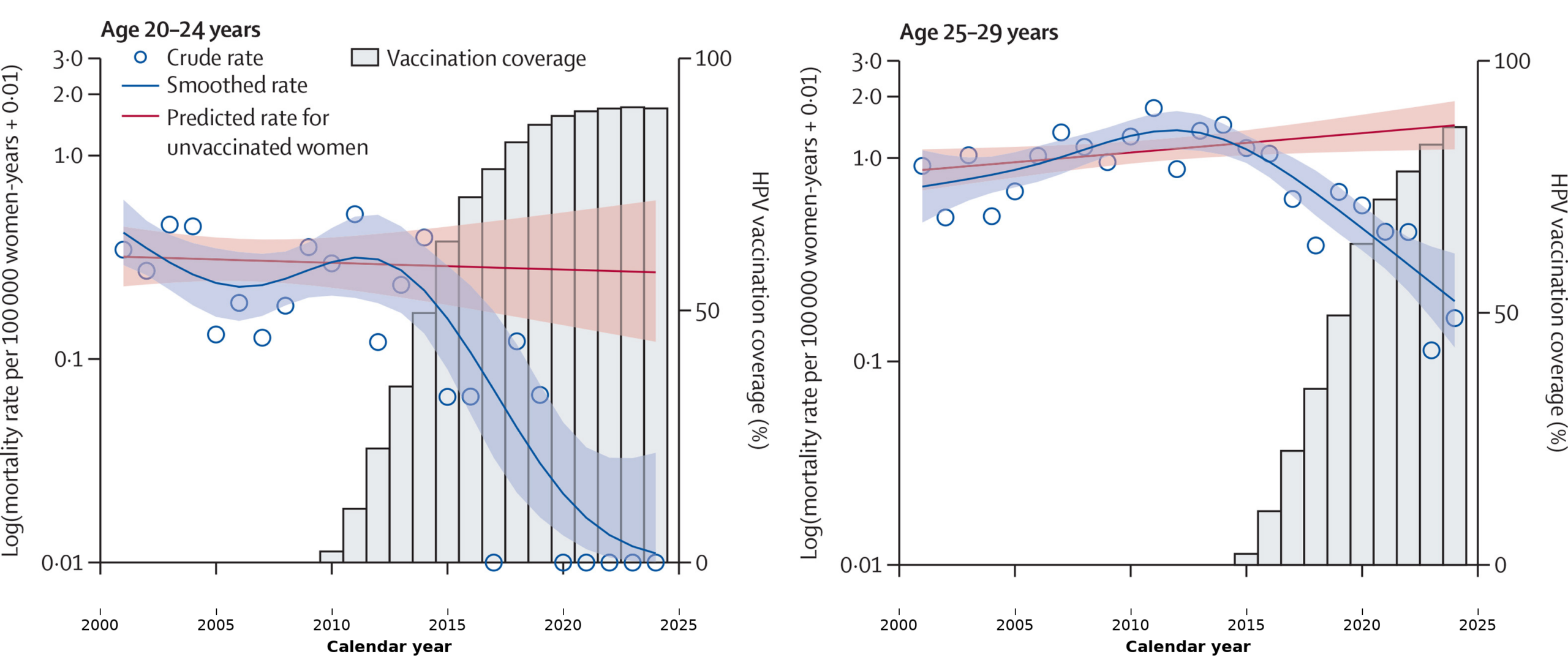
Incredible news this week: the HPV vaccine can literally prevent cancer! This is truly one of humanity’s greatest achievements — and, if you dig into the statistics, it’s even more remarkable.
The headline, from a new study in The Lancet: between 2020 and 2024 in England, zero women aged 20–24 died of cervical cancer. None. For the first time ever.
I posted about this on X, and a predictable chorus of replies came in: ‘But it was only ever a tiny number of women! Something something statistics!’
So I did the statistics. And, wow
How surprising is zero?
In the three five-year periods before 2020, death counts for women aged 20–24 from cervical cancer were 25, 16, and 27—an average of 22.7. It’s true, that’s not very many—less than five per year. But we can only work out how surprising the drop is by using statistics.
If we assume that this is governed by a Poisson distribution—a good first approximation for random events—the probability of observing zero deaths in 2020–24 without the vaccine is:
P(0) = e⁻²²·⁷ ≈ 1.4 × 10⁻¹⁰
That's roughly 1 in 7 billion—ie, essentially impossible.
But weren’t deaths already falling?
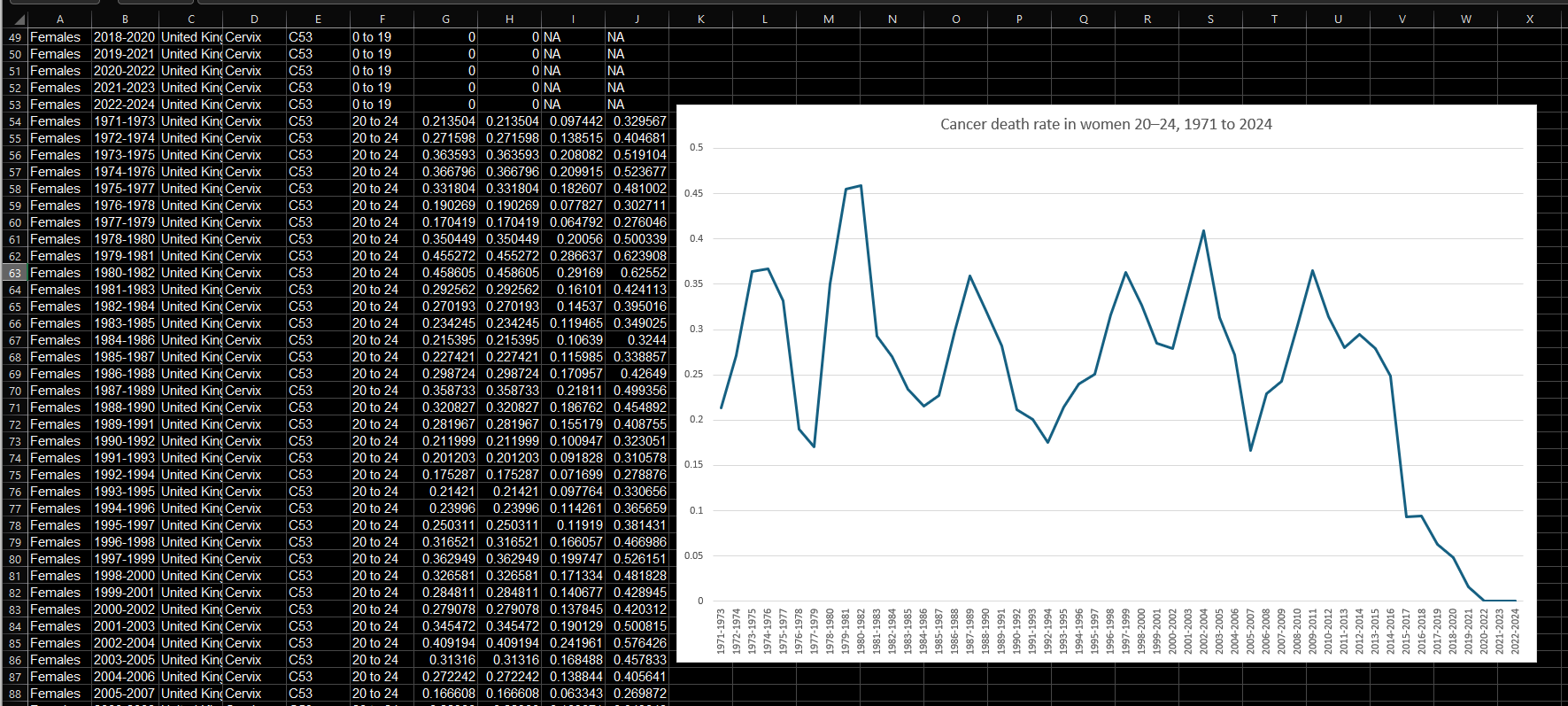
It’s true that cervical cancer deaths have been declining for decades in older age groups—but Cancer Research UK publishes death rates going back to the early 1970s, and for 20–24-year-olds the rate is basically flat (albeit very noisy) across five decades. The collapse to zero only appears in the most recent, mostly-vaccinated cohort. It is genuinely unprecedented in the data.
I did my own research™ and here are the figures in ugly spreadsheet screenshot form:
The Lancet authors model this a bit more thoroughly with the red line in the figure at the top of the post, and it stays essentially flat. The blue line shows the drop—and the confidence band around it shows that, while it's hard to be certain with such small numbers, the fact we saw literally zero deaths means the vaccine is likely over 80%—and maybe 100%—effective at stopping cancer in this age group. (The paper's formal estimate is a relative risk reduction of 100%, with a 95% confidence interval of 81–100%.)
In ages 25–29, the modelled baseline is actually increasing, but we've not had time to see how the mostly-vaccinated cohort will fare yet. Come back in five years!
But why are there no deaths in unvaccinated women either?
Vaccine coverage in this cohort was close to 90%, and herd immunity protected the rest. When the overwhelming majority are vaccinated, HPV struggles to circulate at all, which protects the unvaccinated minority too.
As always, alternative explanations exist and good epidemiology takes them seriously. But the timing and scale of this drop, plus the biological mechanism, all point the same way: we developed a vaccine that stops cancer.
There are lots of other viruses that seed chronic disease. Let’s do those next.
One small warning sign: vaccine coverage in recent years has dropped from ~90% to ~75% in girls—though boys are now eligible and at ~75% too, so hopefully that will keep the herd immunity going. But this underlines how important it is to have an honest, sensitive dialogue about vaccines—because, with infectious diseases and herd immunity, we really are all in this together.
Image adapted from Sasieni & Falcaro, The Lancet 2026, CC BY 4.0.